Insurance Marketplace
MyPolis
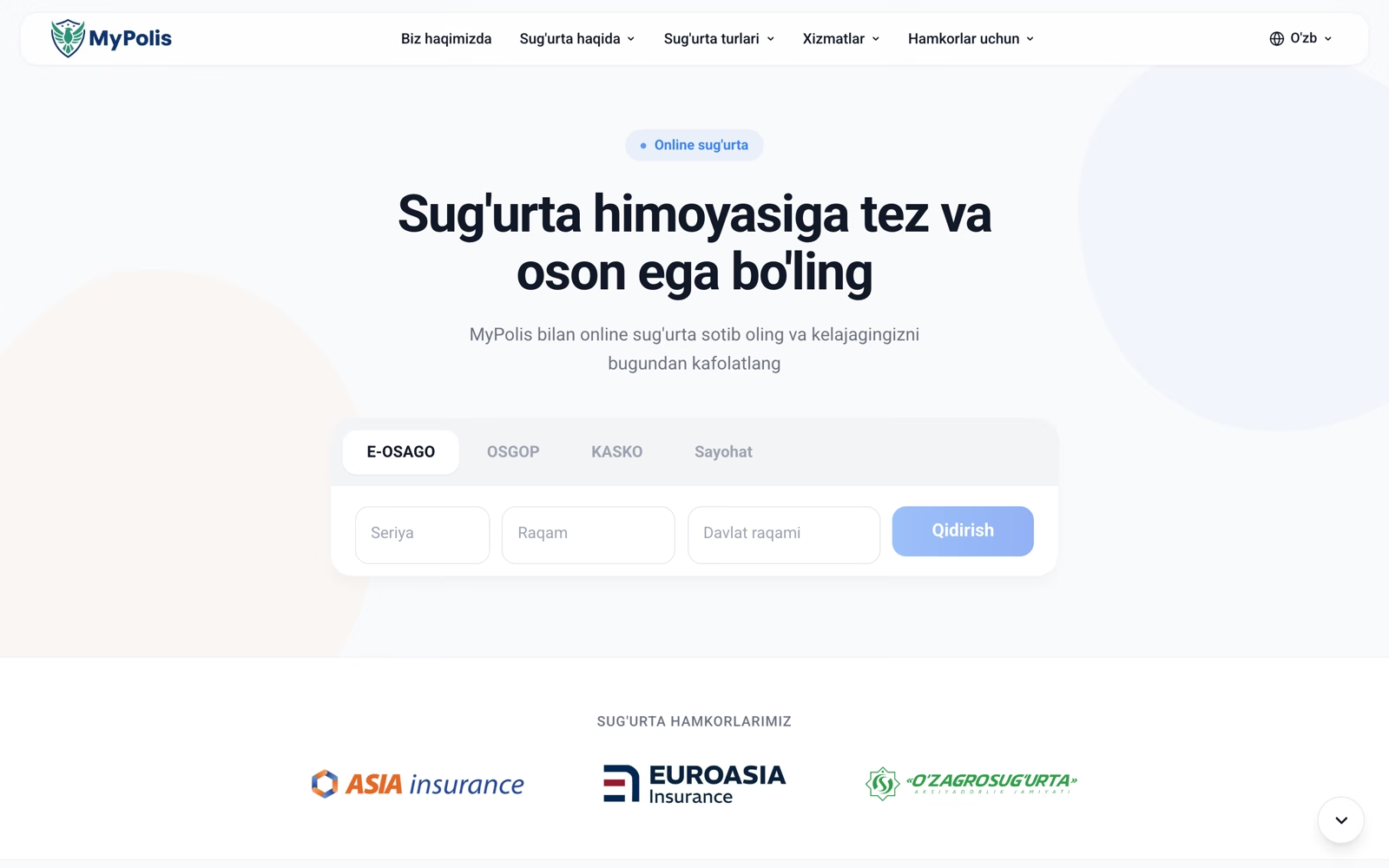
An insurance marketplace where customers buy policies in one place and insurance companies join as listed partners. Delivered payment processing, point-of-sale systems, contract management, an admin panel, and business reporting.
Overview
Buying insurance in Uzbekistan meant visiting each company separately or relying on a broker. MyPolis changes that — it's an online marketplace where customers compare and buy OSAGO, KASKO, and Travel policies from multiple insurers in one place. I built the whole thing: storefront, backend integrations with three insurance APIs, and the admin panel that operations teams use daily.
What I built
Solo full-stack: designed and shipped the customer storefront, the Django REST backend, and a separate admin panel — all from scratch.
Wired three insurance providers (EuroAsia, Asia Insurance, O'zagrosug'urta) into a single purchase flow — each with its own API quirks, but the same smooth experience for the customer.
Built a Telegram Mini App dashboard for real-time revenue and policy monitoring — so the ops team can check numbers from anywhere.
Owned all data modelling — contracts, vehicles, drivers, commission rates, promo codes, and a custom user model ready for national ID and OneID SSO.
Architecture
Three applications talk to each other: a Next.js storefront serving customers in Uzbek and Russian, a Django REST backend that proxies calls to each insurer's own API, and a separate admin SPA for operations. Each insurance provider lives in its own module on the backend, so adding a new one doesn't touch existing ones.
Under the hood
Atomic policy purchase with automatic rollback: creating a contract wraps the local database write, the insurer API call, and the payment URL retrieval in a single transaction — so if the payment link fails after the insurer has already registered the policy, the system rolls back and fires a Telegram alert instead of silently losing the sale.
Commission and promo-code engine: broker percentages are stored per company and product type, and promo codes support both percentage and fixed-sum discounts scoped to specific insurers with date-range validity — all re-validated at purchase time so nothing slips through stale.
Telegram dashboard authentication using Telegram's own HMAC initData spec — the backend verifies the cryptographic signature and checks the timestamp freshness before issuing tokens, so the dashboard is only accessible to whitelisted admins.
What I learned
Integrating multiple third-party APIs taught me to expect inconsistency — each insurer had different error formats, timeouts, and edge cases that only appear under real load.
Keeping the provider integrations in separate modules from day one meant I could swap or update one without fear of breaking the others.
Built with
Frontend (Storefront + Admin)
- Next.js 16
- React 19
- TypeScript 5
- Tailwind CSS 4
- shadcn/ui
- TanStack Query v5
- next-intl
Backend
- Python 3.9
- Django 4.2
- Django REST Framework 3.14
- djangorestframework-simplejwt
- django-modeltranslation
Data
- PostgreSQL
- Django ORM
- pandas
- openpyxl
Infra & Tools
- Docker
- Nginx
- Telegram Bot API
- Gunicorn
- Whitenoise